


Market Optimism Still Makes Sense Despite High Anxiety.
“Wow, markets have really been going up this year. It can’t keep going like this, can it?”
If you’ve found yourself thinking or saying those exact words recently, you’re not alone. Nearly every investor I’ve talked to has voiced some version of that same concern, often followed by a laundry list of unsettling headlines they’ve seen in the financial media. It’s understandable. When markets reach new highs, we should be celebrating but instead, many of us start to feel that creeping sense of worry. What if it all comes crashing down? For investors, there’s a double meaning to the phrase, “high anxiety,” and the feelings are far more common than you might think.
A Little Humor at Our Worrying Nature.
There’s an old Mel Brooks comedy from 1977 called, “High Anxiety”. In it, Brooks plays a psychologist surrounded by characters with, you guessed it, all sorts of anxieties. At one point, he sings a tune where the key lyric is, “High anxiety. You win.” It’s a funny scene, but it also hits close to home for investors. When the markets are strong, we start feeling uneasy because they’ve been strong. We’ve benefited from the rise, but now we’re waiting for the other shoe to drop. So why do we get so anxious when things are good?
Blame It on the Brain.
You don’t have to be a psychologist to appreciate what’s happening here. As humans, our ancient wiring helps explain it. The part of the brain responsible for our fear response is called the amygdala, and it evolved to keep our ancestors alive. Tens of thousands of years ago, misreading a rustle in the bushes could mean the difference between life and death. If it was just a squirrel, no harm done. But if it was a lion, the stakes were high. Overreacting kept us alive, so our brains learned to err on the side of fear.
Fast forward to today, and that same “fight or flight” instinct still kicks in. Only now, market headlines trigger it instead of predators. When doom and gloom fill the news cycle with reference to interest rates, elections, or global tensions, it stirs that ancient alarm system. Fear grabs our attention. In fact, manufacturers built entire industries on that premise, because fear sells better than optimism.
But here’s the thing: History doesn’t support fear when it comes to financial markets.
Why Educated Optimism Makes Sense.
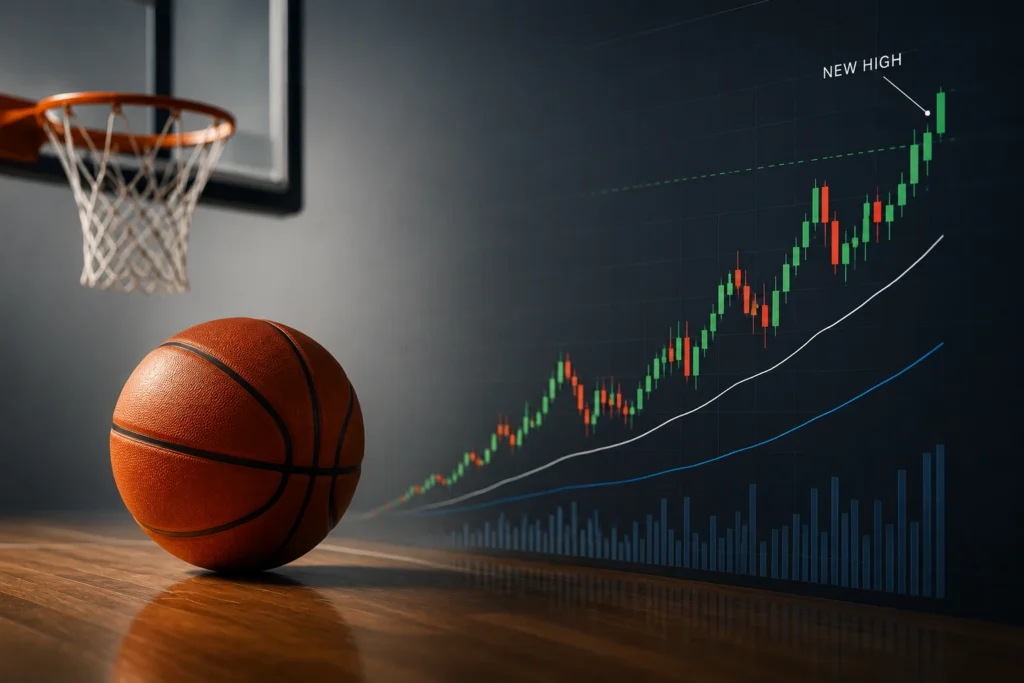
While no one can predict exactly what the market will do next week or next year, we can look to history for perspective and reassurance. Over decades, the stock market has experienced countless highs and lows. But the long-term trend is up and to the right. Research from Dimensional Fund Advisors found that, 81% of the time, the S&P 500 was higher one year after a record high, and 86% of the time, it was higher five years later.1 In other words, a new market high has historically been more of a beginning than an ending. Even week-to-week, the data shows a subtle pattern: The average return in the week following a new market high (0.26%) has been slightly better than the average for all weeks (0.22%).1 So, market highs aren’t the “danger zones” our brains make them out to be. They’re often just milestones on a continuing journey of growth.
Prices Reflect Progress and Expectation.
Another reason for optimism lies in how markets work. Every stock price reflects the collective expectations of millions of investors, both professional and individual, all weighing future risks and rewards. No rational investor buys a stock expecting it to lose value. Even at higher prices, each transaction reflects confidence that there is potential for growth ahead. If prices didn’t offer positive expected returns, then no one would buy, and prices would fall until more buyers than sellers step in expecting positive returns. That’s market equilibrium. It’s the point where buyers and sellers agree that the future offers a fair return for the risk. So even at market highs, the very act of people continuing to buy reflects a shared belief in the long-term potential of companies to grow and innovate.
Planning Defuses Anxiety.
Of course, optimism doesn’t mean naivety. Market downturns are inevitable; they’ve happened before and will happen again. The key is to plan for them. One effective approach is to structure your portfolio so that you have enough cash and bonds to cover your lifestyle and goals for at least seven years. A study of global market history found that even in the worst cases, such as the Great Depression, the longest full recovery period from a high to a low and back again was about seven years. During the 2007–2009 financial crisis, recovery took roughly five and a half years. So if your portfolio is designed for a long-term horizon, you may have greater flexibility to avoid selling stocks during market downturns. If you’re wondering what’s best for your situation, it’s a good idea to reach out to a financial professional who can walk you through your options.
When Anxiety Wins, We Lose.
Letting fear drive decisions is what truly hurts investors. Selling during downturns, sitting on the sidelines while markets recover, or chasing the latest “safe” trend can all interrupt the power of compound growth that builds wealth over decades. Yes, there will always be reasons to worry. But if markets at all-time highs make us nervous, and markets at lows make us fearful, when exactly do we feel comfortable investing? That’s why adopting an educated optimism based on history and long-term perspective is so important.
Don’t Let High Anxiety Win.
Mel Brooks sang it for laughs but for investors, it’s a real-life refrain: “High anxiety. You win.” The goal is not to eliminate all worry; that’s part of being human. But we can keep that ancient amygdala in check by reminding ourselves of the evidence. “Educated optimism”, writes investment pioneer David Booth, “is an antidote for anxious uncertainty.” Markets rise and fall but over time, progress and innovation have helped those who stayed the course.
So, the next time you hear the noise of fear in the financial bushes, take a breath, look at your plan, and remember that the rustle probably isn’t a lion. It’s just another step forward in the market’s long, upward march. At Foster Group, truly cared for means that our clients’ goals always come first. We’re partners in the pursuit of a meaningful and generous life.”