



I commonly hear people say that they’re ready to invest when something related to markets looks different than it does now. On the flip side, they want to sell investments now and wait until things look different before reinvesting.
That word “different” could mean a lot of things: less market volatility, lower prices (“buying the dip”), or more clarity around a geopolitical event to name a few. But all of those ideas hinge on the same assumption, that it’s better to invest when there’s more information about what comes next. The problem is that no one knows what’s coming next.
Why Predicting Market Winners Is Difficult
We all remember the global shutdowns in 2020, following the outbreak of COVID. Looking back, it seems obvious that travel-related companies (airlines, hotels, cruise lines, etc.) were going to suffer greatly during the initial outbreak. How many would have said those stocks would rebound as the world opened back up and lockdowns eased? After all, it was inevitable that we’d all get back to life as usual at some point, right?
Now, think back to what we knew in March 2020. At the time, we didn’t know the world could effectively shut down. We didn’t know there would be government stimulus payments for individuals or special loan programs for the companies most impacted by restrictions. We didn’t know what treatments would prove effective or the prognosis for those diagnosed. We didn’t know how quickly markets would recover after the initial drawdown.
That’s the point: Hindsight makes the path through that time seem clear, almost inevitable. But in the moment, it was impossible to predict what would happen next; what the people around you would do; or what second-, third-, and fourth-order impacts of a decision or event would be.
What the Patchwork of Returns Shows About Market Leadership
This applies to investing, as well. It could feel obvious that you should’ve bought one stock or sold another. But in the moment, we can’t know where markets are going or how they’ll respond to world events. Stocks that we think will surely boom could bust, and whole industries that feel like a sure thing could struggle unexpectedly.
Take a look at the chart below, which ranks asset classes by performance, from best to worst, each of the last 11 calendar years. How many people predicted even 10% of these rankings? Probably very few, if any.
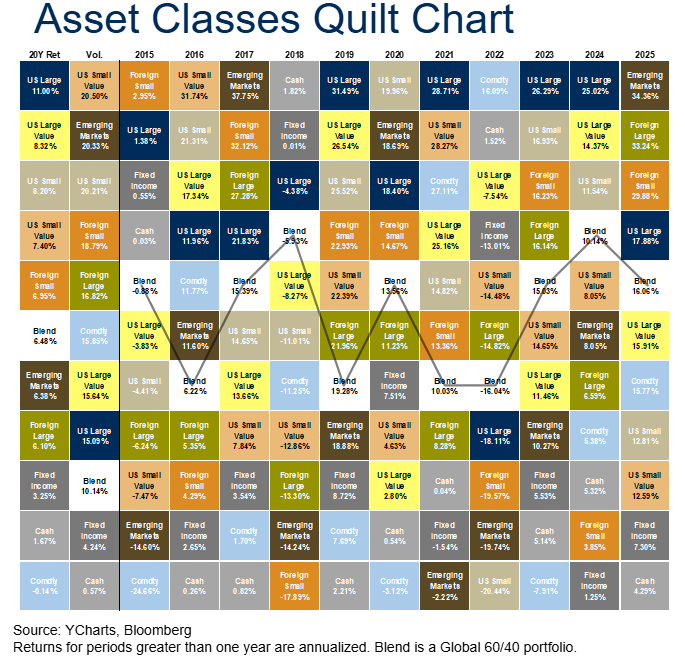
The takeaway is simple: There is no consistent pattern to which market segment will lead next. Last year’s winners could fall behind, while last year’s laggards could move to the top.
How Diversification Helps Investors Avoid Chasing Performance
With that kind of uncertainty, what should investors do? Historical data indicates that being well diversified, patient, and staying the course through the ups and downs of the market could lead to better outcomes over long periods of time. Said another way, you can’t benefit from appreciation in a section of the market you don’t own. You have to be present to win.
Another benefit of this approach is that it takes the guesswork out of investing. Rather than trying to predict what will happen next or get every world event right, investors could stick with their long-term plan and let markets do the work. You don’t need to predict or even guess correctly, which removes some of the pressure from investing. Past performance is no guarantee of future results, please consult an investment professional regarding your individual objectives and circumstances.
For a recent example of this, let’s take a look at international stocks for US-based investors. The MSCI ACWI ex USA IMI is a representation of broad non-US market exposure. In 2025, the index posted a return of 32.67% – its highest calendar-year return in the last 15 years.1 For comparison, the S&P 500 returned 17.88%.2 International markets have also continued to outperform in early 2026. For much of the 2010’s, that result has been the reverse, with the S&P 500 routinely outperforming international markets. For example, if you’d concentrated in US-based stocks with that in mind, you would’ve missed substantial growth last year and so far this year. This is just one example, but there are plenty more out there.
Staying Invested Matters More Than Predicting the Market
The moral of the story is that successful long-term investing isn’t about finding the next big thing before everyone else. It’s very difficult to consistently predict which stocks, sectors, or countries will outperform in any given year. Instead, successful long-term investing is about broadly investing in the market, staying invested through market volatility, and trusting that markets reward patience over prediction.
If you’d like to talk through whether your portfolio is aligned with your long-term goals, reach out today. We’d be happy to help. What does it mean to be truly cared for? It means we understand your passions and use proven methods to help you reach your goals.
1 – MSCI ACWI ex USA IMI Index Factsheet (USD), Feb. 27, 2026.
2 – S&P Dow Jones Indices, Index Dashboard: U.S., December 31, 2025