


I’ve never been one to shy away from a sports hot take. Before the NBA Finals started, I texted a friend. “Spurs in 5.”
I wasn’t following the league closely this season, but I knew the Knicks had been on a dominant run. They came into the playoffs as big underdogs but by the time they reached the Finals, they had won 11 in a row and posted the largest playoff point differential the league had seen over that stretch.
Naturally, I assumed some part of it had to be luck or momentum that wouldn’t last.
Boy, was I wrong. Knicks in 5.
The Knicks won the series in five games and finished the playoffs with a point differential that topped the Warriors’ runs in the 2010s, the early 2000s Lakers, and the Bulls teams from the 1990s.
Why Strong Trends Could Last Longer Than Expected
When something has been going well for a while, the instinct is to push back on it, to assume it can’t keep going and is due to come back down. You hear it all the time in sports:
“They’re due.”
“There’s no way this keeps up.”
That thinking comes from somewhere real. Over time, extremes tend to revert toward normal. Where people get tripped up is assuming that happens on our timeline. Just because something has been strong doesn’t mean that it’s about to weaken. Sometimes trends reverse quickly. More often, they continue far longer than we expect.
I see that same instinct show-up in investing all the time.
When markets are at or near all-time highs, the reaction is almost identical. It feels like things have gone too well for too long, like this has to be the point where it turns. That feeling makes sense. It’s just not how it usually plays out.
What History Tells Us About Market Highs
Since 1950, the S&P 500 has closed the month at an all-time high 36% of the time. If you expand that to include periods within 5% of a high, it jumps to 63%.1
The lived experience of the past 70-plus years is that the stock market spends most of its time at or near all-time highs.
And what happens from there isn’t always what people expect. New highs don’t usually mark the end of a run. More often, they reflect a trend that’s already in motion.
In fact, returns from all-time highs have historically been as good or better than at other points.
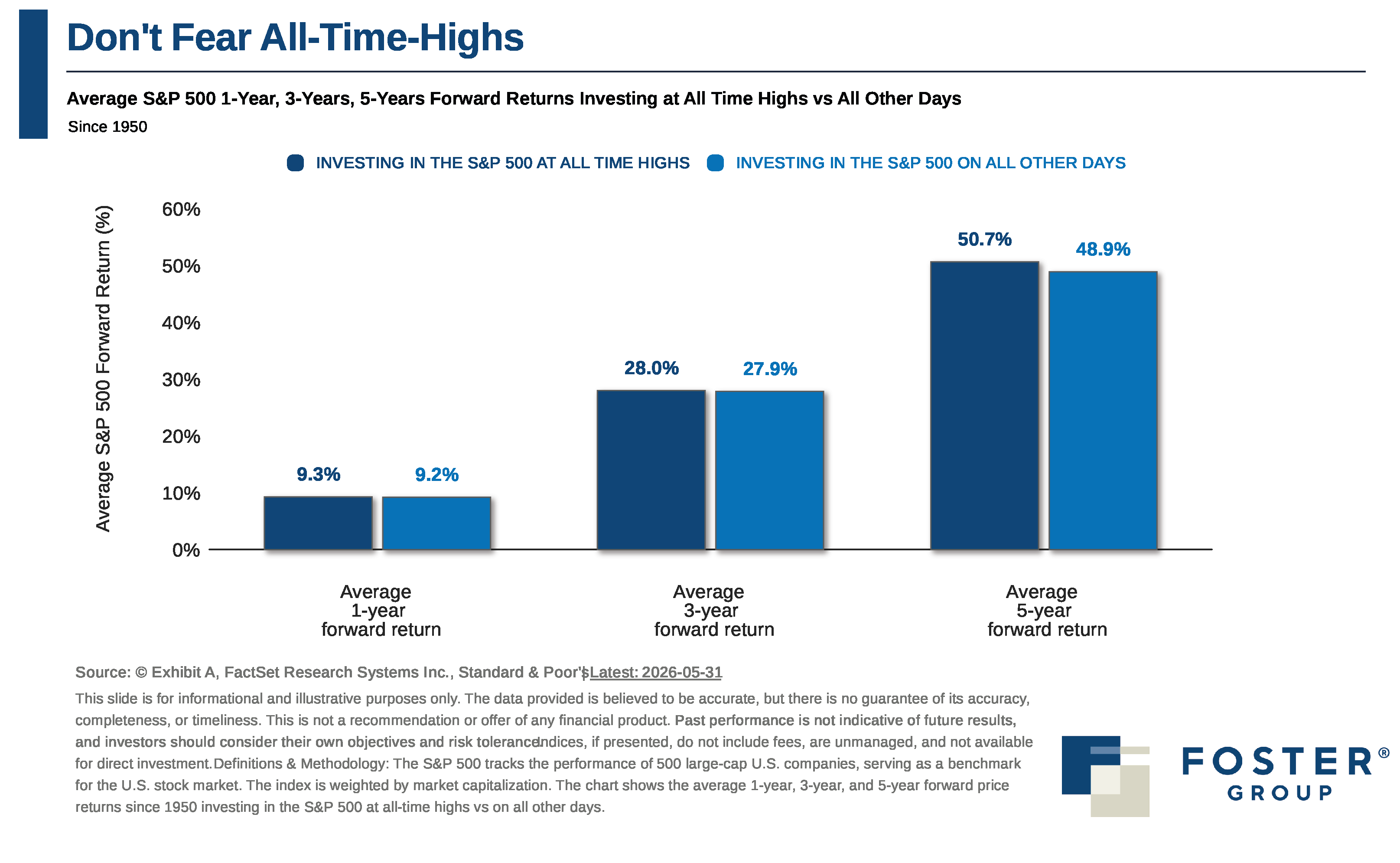
The data runs directly against the instinct most people have. Buying at a high feels like you’re late, like you missed it, like you’re stepping in right before things turn. Historically, periods of strength have more often marked a continuation of the trend than the end of it.
The Cost of Waiting for a Better Entry Point
That doesn’t mean the market won’t have pullbacks. It will. Even the best teams lose games along the way. The Knicks lost Game 3 and were down big in Game 4, but neither changed the direction of the series.
The same is true in investing. Short-term setbacks don’t necessarily change the long-term trend.
The real question isn’t whether there will eventually be a better entry point. It’s what happens while you’re waiting for it. Because just like the Knicks’ run, the market doesn’t stop moving because it feels like it should.
And over time, the cost of waiting is often higher than the cost of getting started.
When markets reach new highs, it’s natural to wonder what comes next. At Foster Group, we take the time to understand what’s most important to you and build a long-term strategy designed to help you pursue your goals through every market cycle. Reach out today to discuss how your financial plan can help you stay focused through changing market conditions.
1 – S&P 500 data sourced from Dimensional Fund Advisors Returns Web, as of June 2026. Author’s calculations.