



The short answer to this question is that there is no “one-size-fits-all” approach to nonprofit investing. Each organization is different and has its own set of unique goals and challenges.
Although this is the case, learning how other nonprofits invest can help ignite a meaningful conversation within your own organization. This can potentially lead to improvements or increased clarity around why your nonprofit’s investment allocation might be similar or different from others.
This article will review two industry studies, the NACUBO Study of Endowments and the Association Investment Policies, Practices and Performance. These two studies provide insight into the asset allocations for two unique types of nonprofits of various sizes. At the end, we will discuss five key takeaways.
NACUBO Study of Endowments
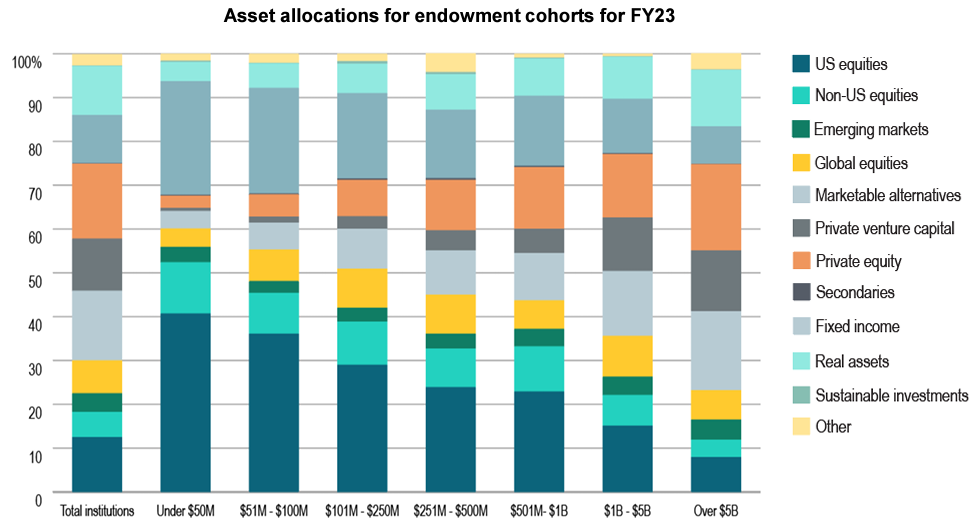
For fifty years, the National Association of College and University Business Officers (NACUBO) has published an annual study of the endowments of institutions of higher learning. In 2023, 688 colleges, universities, and education-related foundations with a median size of $209M completed the survey. The study covers a range of topics, including endowment spending, return objectives, investment returns, and asset allocation.
The illustration below, from the study, shows the average asset allocations for several different endowment cohorts.
Association Investment Policies, Practices, and Performance
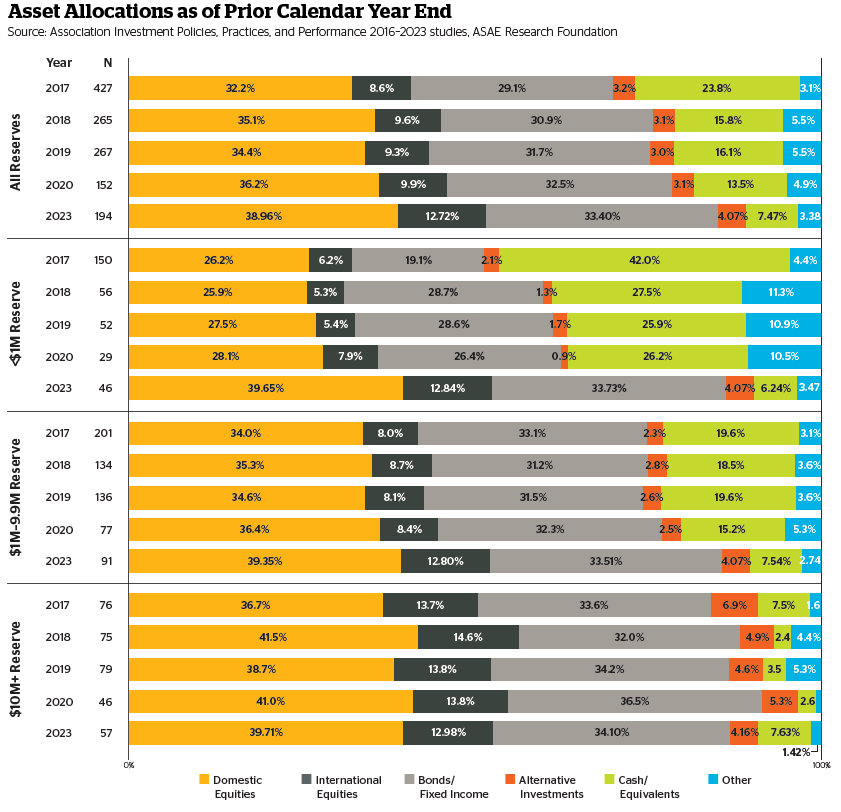
This second study has been produced since 2014 and in 2023, it included 194 respondents from the American Society of Association Executives database. It is relatively evenly distributed between nonprofit trade and professional associations, a unique group of organizations from the NACUBO study of university endowments.
The illustration below shows the average asset allocations for various sizes of reserve portfolios by calendar year end.
What do these studies tell us about how nonprofits invest? Here are five key takeaways:
1. Investments are broadly diversified.
Both illustrations show that these nonprofits, large and small, hold a range of asset classes in their investment portfolios. This is visually represented by the multiple colors for each cohort.
2. Equity investments are favored.
On average, all organizations allocate a sizeable portion (over 50%) to equity investments.
3. Larger institutions tend to be more aggressive.
Both studies show that larger institutions tend to hold more risky asset classes, like equities and real estate, while smaller organizations are more conservative.
4. Larger institutions hold more in private and alternative investments.
Both studies reflect that larger institutions hold a bigger percentage of assets in investments, like private equity, venture capital, real assets, and various alternative investments. It’s also important to note that respondents in the NACUBO study tend to be larger than the study focused on nonprofit associations and, therefore, tend to hold more in these types of asset classes.
5. Endowments for higher learning and nonprofit associations allocate differently.
This may seem obvious, but it is a key point. Endowments often have different investment objectives when compared to nonprofit associations. They tend to distribute an annual spending rate, e.g., 5% plus inflation, while a nonprofit association’s investment portfolio may function as a long-term rainy-day fund. In view of these differences, it makes sense that the study shows that these two groups allocate differently. For instance, associations hold more cash assets and are generally more conservative.
There are certainly limitations to the studies referenced. For one, they only cover endowments for higher learning and nonprofit associations, not the entire universe of nonprofits operating with a wide range of missions.
Although this is true, hopefully these takeaways help ignite meaningful conversations within your own nonprofit organization. As a starting point, here are some of the questions that could come up when reviewing the takeaways:
– How is our organization different from others and why?
– Do we have a plan in place to reach our unique objectives, and is it known and understood by all involved in overseeing investments?
– Are we taking too much risk or too little, given the goals and financial position of our organization?
– Are we adequately diversified?
– What is our cash reserve policy?
– If we are not an endowment for higher learning, e.g., Yale, Harvard, does it make sense to hold a portfolio like these organizations?
– Should we invest in alternative asset classes?
To end where we started, there is no “one-size-fits-all” approach to nonprofit investing. Each organization is different and has its own set of unique goals and challenges. Consider taking the time to review these studies with your own organization as you pursue your objectives. If you’d like an outside perspective reach out today!