



Family Caregiving Is More Common Than Many Realize
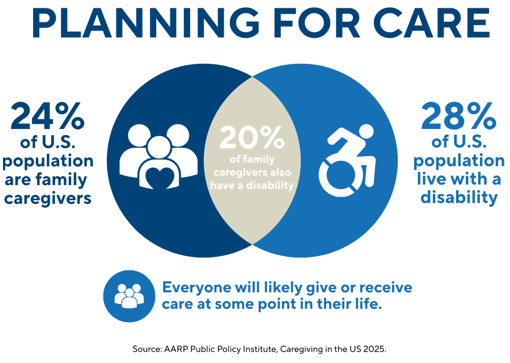
An estimated 63 million Americans, nearly 1 in 4 adults, provide ongoing care to someone in their life that has a disability or a medical condition. 1 These unpaid family caregivers help with multiple tasks, including Activities of Daily Living, or ADLs, such as bathing, dressing, or feeding, and Instrumental Activities of Daily Living, or IADLs, such as shopping, managing finances, preparing meals, and transportation.2,3 Caregivers may also help coordinate (or provide) medical care, manage technology and assistive devices, or simply check in and provide some company for a loved one living alone.
Disability and Care Needs Can Carry Real Costs
More than 1 in 4 adults, 28.7% in the United States, have some type of disability.4 Most disabilities are invisible5, and not all people with disabilities require someone else to care for them. However, on average, households including a person with a disability do require 28% more income ($17,690 per year) to maintain the same standard of living as a household without a member with a disability. 5
Planning Ahead Is an Act of Care
Care is all about quality of life for our children, our parents, partners, neighbors, friends, and for ourselves. Care, even “unpaid care,” has significant costs and can be difficult to replace if a caregiver can no longer provide it.
At Foster Group, we believe it’s an act of generosity to provide care for someone you love. It’s also an act of generosity to care for yourself and plan ahead for your future care needs. Here are three important steps to consider regarding current and future care for yourself and loved ones:
- Talk to your advisor about the potential costs of care and how to incorporate those costs into your financial and estate plans.
- Talk to your family about your own preferences for care if you need it and their preferences if someone needs to care for them.
- Document these preferences and put a care plan in place before it’s needed.
3 https://www.cms.gov/research-statistics-data-and-systems/research/mcbs/downloads/2008_appendix_b.pdf
4 https://www.cdc.gov/disability-and-health/media/pdfs/disability-impacts-all-of-us-infographic.pdf
5 https://cephable.com/2024/04/23/the-invisible-burden-understanding-the-disability-tax/