

Have you ever been to The Cheesecake Factory?
Famous for its delicious brown bread and delectable desserts, it’s a crowd-pleaser with something for everyone. Perhaps its most distinct feature is the giant, spiral-bound menu book filled with dozens of beverages, appetizers, soups, salads, entrées, and desserts. Choosing what to eat is no small feat when the selection is so vast! Beyond knowing what you don’t like, what’s a hungry but overwhelmed diner to do?
For many generous families, charitable giving could feel a bit like sitting down at The Cheesecake Factory with an empty stomach and only a vague idea of what sounds good. They know they want to give and have the financial resources to do so, but they’re not sure where their generosity will have the greatest impact or how to make a wise giving decision.
That’s where a trusted financial advisor could make all the difference. In my work with generous multigenerational families, we approach the lifelong pursuit of intentional philanthropy through three key ideas:
1. Gauge Your Appetite: Define Your Charitable Giving Priorities.
Before choosing a new organization to support or responding to another request for a donation, take some time to understand the causes and organizations that currently motivate your generosity. Think about three to five meaningful gifts you’ve made over the past few years and make a note of the following for each:
- Who does the organization help?
- What problem is the organization trying to solve?
- Where, geographically, is the organization making a difference?
What patterns emerge? Perhaps several of the organizations you support focus on K-12 education, basic needs like food and shelter, or health-related causes. Maybe the organizations are all located in your local community, places you’ve lived in the past, or international locations you’ve visited.
Consider plotting your meaningful charitable gifts on our founder Jerry Foster’s generosity matrix, shown below. This innovative visual tool organizes charitable fields of interest along the vertical (y) axis, starting with basic needs like food, water, and shelter at the bottom and progressing upward according to Maslow’s Hierarchy of Needs. Geographic areas of impact are organized along the horizontal (x) axis, starting with individuals on the left and moving toward local communities, statewide, nationwide, and international impact.
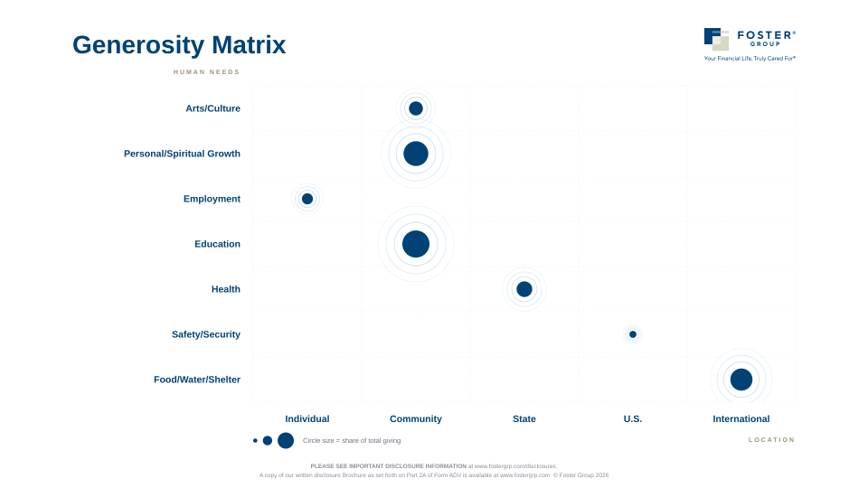
The goal isn’t to fill every space or make a gift in every category. Rather, it’s to visualize where you’re giving today and how to use that information to inform your ongoing strategy. Are there notable gaps you’d like to fill? Are you inadvertently doubling or tripling up in one field of interest or geographic area? Start by measuring your appetite before ordering something off the menu.
2. Know What’s on the Menu: Find the Right Charitable Organizations.
Once you’ve identified your key fields of interest and the geographic areas you’d like to impact, the next challenge is knowing which organizations are doing high-quality, meaningful, and sustainable work in those areas. Are you interested in supporting a nonprofit with a long history and proven track record? Or does the idea of supporting a newer charitable organization with an innovative approach excite you more?
If you know you’re generally in the mood for pasta, The Cheesecake Factory menu suddenly becomes much more manageable. Yes, you’ll still have to narrow it down by pasta shape, sauce, vegetables, and protein, but at least you could leave the grilled fish entrées behind without second-guessing yourself.
The same is true when evaluating charitable organizations. Understanding a nonprofit’s mission, impact, leadership, operations, and financial health could help you feel more confident about where your charitable dollars are going. Through research and evaluation, you may even discover a new favorite organization you didn’t know existed! Bigger isn’t always better. It’s more about finding the right fit for your philanthropic priorities.
3. Ask the Expert Chef: Get Guidance on Your Charitable Giving Strategy.
Think of your financial advisor as the expert chef who knows the menu inside and out. When generous client families ask me for charitable giving recommendations, they know I care deeply about the experience they’ll have as donors. They also know I have a genuine understanding of their personalities, preferences, hopes, and concerns, which allows me to tailor recommendations to their interests and values.
In my work with multigenerational families, I often make charitable introductions, share firsthand insights about organizations doing meaningful work, and help families recognize the personal values that motivate their generosity. Relationships matter, too. Financial advisors often have connections with local nonprofits, community foundations, and charitable leaders who could help identify needs and opportunities that families might never discover on their own. And when you’re ready to make gifts, an advisor could help ensure that they fit within your financial plan and that you’re using the most tax-advantaged giving strategies available.
Whether it’s The Cheesecake Factory menu or a new charitable cause to support, don’t be shy! Ask the expert what they think. After all, some of the best restaurant dishes I’ve ever tasted were suggested by the expert chef, who knew just what I’d enjoy.
Charitable giving could be so much more than responding to a donation request or maximizing a tax deduction. The greatest joys of philanthropy come from connecting your resources with the causes, communities, and values that matter most to you. Remember, you don’t have to navigate the entire menu alone. With the right guidance, you could turn the desire to give into a thoughtful philanthropic strategy and enjoy the experience along the way. Foster Group takes the time to truly know our clients—not just their financial goals, but what’s in their hearts.
Bon appétit!