



Retirement planning can be intimidating. It seems so far away, and it can be easy to tell yourself that you’ll start saving next year or in a few years. And the next thing you know, five years have passed, and you’re now behind and playing “catch up”.
As a Football enthusiast, I like to think about it this way: If you start off with a 14-0 lead in the first quarter vs being down 14-0, you will feel a lot better about your chances of winning the game. If you are down 14-0, you’re not out of the game, but you just have a larger hill to climb. You can think of retirement planning in a similar fashion.
If you’re eligible or already participating in a 401(k) plan, here are some of the most important questions clients often ask me as a 401(k)-plan advisor.
- How much should I be contributing to my 401(k)?
- Am I on track to retire?
- Should my contributions be Roth or Pretax?
- Where should I invest my money?
These are valid questions to ask when you’re signing up for your company’s retirement plan.
How Much Should I Contribute to my 401(k)?
Before I get to this question, I want you to know that getting started is not easy, even for those in the financial industry. If I was to have a conversation with my younger self, I would have stressed the importance of enrolling once I became eligible. We all have car payments, student loans, and rent. It’s easy to tell yourself that you’ll start contributing once you start making more money, but then come kids and childcare expenses. It’s much easier to build a budget when you’re accustomed to contributions already coming out of your check.
A great starting point is to make sure you are at least maximizing your employer match. For example, if your employer is matching 100% of the first 4%, try to at least put in 4%. Also, some retirement plans offer an automatic increase feature that can help get you to your ultimate goal over time. The easiest way to build up your contribution percentage is to set up an automatic contribution increase of 1% or 2% each year. Finally, we encourage participants to increase their contribution with any pay increase. When your pay increases, typically you don’t “feel” the extra dollars going into your 401(k).
A good goal is to, eventually, save 15% of your pay—this, of course, is best calculated with your team of professionals (tax advisor and financial advisor), who would know your specific financial situation best. This includes your own contributions, along with any employer matching dollars. For most individuals it’s not realistic to start that high but over the course of time, you can get there.
Am I on Track to Retire?
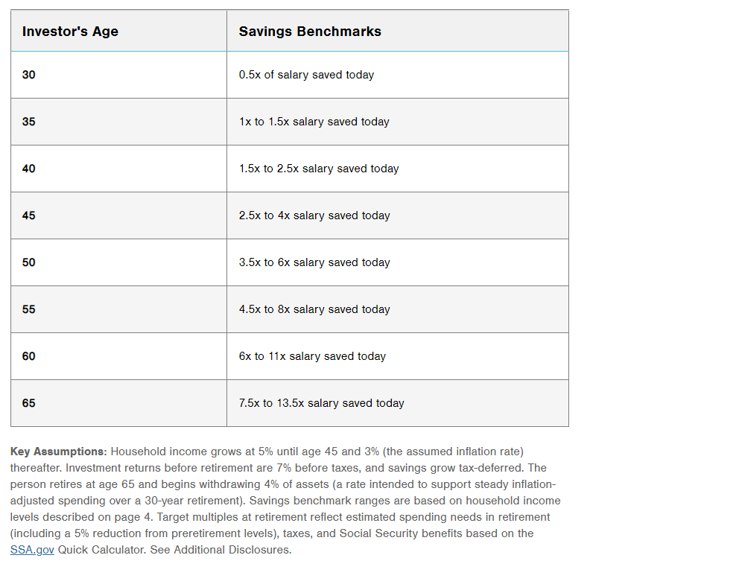
After you’ve been contributing to your 401(k) plan for a while, you might ask yourself if you have enough saved to retire. Roger Young and his team at T. Rowe Price recently wrote a great article that gives you a “Savings Benchmark.” A savings benchmark is the percent of income you should have saved by a certain age. In the example below, if you’re making $50,000, you should have approximately two times that amount, or $100,000, saved by the age of 40. This is not a “one-size-fits-all,” because everyone has different circumstances. At Foster Group, this is something we discuss in our 1:1 meetings with our 401(k) clients. I encourage everyone to sit down with an advisor and discuss this topic. Below is the chart referenced in the article that illustrates a Savings Benchmark at various times throughout your career.1
Should my 401(k) Contributions be Roth or Pretax?
When you contribute to the Roth portion of your 401(k), there is no current tax benefit. The benefit is in the future, because it creates a pool of tax-free income during retirement. With a Pretax contribution, you get a tax break now, but you’ll pay tax later when you take the money out. Your age and income level are two factors that may influence which one is right for you. We encourage you to ask a tax professional which one makes the most sense in your situation.
Where Should I Invest My Money?
Most retirement plans have anywhere from 10 to 30 different investment options to select from. Some have even more. This can be overwhelming! We try to simplify the decision-making process for our clients with a “Do It for Me Option” and a “Do It Myself Option.” Target Date portfolios are a great “do it for me” option. These portfolios automatically adjust over time, depending on your proximity to retirement. When you are far from retirement, the funds are focused entirely on growing your dollars. As you get closer to retirement, they continue to be focused on growth but steadily create a pool of dollars that are more stable. What’s great about Target Date funds is that you simply put the dollars in and the fund manager does the work. Often these funds are some of the most cost-efficient options. If you go this route, you would select the fund that coincides with the year you think you might retire.
According to an article written by CNN in December of 2023, “At the end of 2020, the vast majority of plans (86%) offer Target-Date funds as an option.” 2 If you happen to be in one of the plans that does not offer target-date funds, I encourage you to take a look at prebuilt models the advisor or recordkeeper has put together. Model portfolios work in a similar fashion as a target-date, but there is no auto-adjustment for age and stage of life. I would consider this a hybrid between “do it for me” and “do it myself.”
If you want to choose your own investments, the “do it myself” option, we suggest asking an investment advisor to help you select the funds. Putting together the right mix of investment options at various points throughout your career is a challenge. That’s why you should consult someone who has some expertise.
Retirement planning is a journey, and it is natural to have questions along the way. Hopefully this article has helped you understand the most important questions to ask and how to successfully answer them. And one more thing, it’s never too late to start! There’s always a chance to turn the game around.
Our goal is to help you feel confident and empowered in your retirement planning. As you navigate these decisions, don’t hesitate to reach out. We’re here to help. GOPACKGO
1Savings Benchmarks by Age Chart: https://www.troweprice.com/personal-investing/resources/insights/youre-age-35-50-or-60-how-much-should-you-have-by-now.html
2https://www.cnn.com/2023/12/02/success/target-date-funds-401k-explained/index.html