



History of U.S. Federal Income Tax Rates: More Than 100 Years of Tax Changes
The modern federal income tax began with the ratification of the 16th Amendment in 1913, giving Congress the authority to tax individual income. Since then, the top marginal tax rate has changed dramatically, from single digits in the early years to more than 90% in the 1940s and 1950s. At 37% today, the top marginal rate is significantly lower than the long-term average of 57.8%. Interestingly, when adjusted for inflation, the income level at which that top rate applies has also varied significantly, reaching much higher levels in some periods and much lower levels in others. The takeaway is simple: Tax rates and brackets have changed considerably throughout history, reminding investors that today’s tax environment is a snapshot in time and underscoring the value of building flexibility into long-term financial plans.
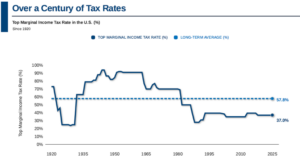
Source: © Exhibit A, Tax Foundation. This is for informational and illustrative purposes only. The data provided is believed to be accurate, but there is no guarantee of its accuracy, completeness, or timeliness. This is not a recommendation or offer of any financial product. Past performance is not indicative of future results, and investors should consider their own objectives and risk tolerance. Indices, if presented, do not include fees, are unmanaged, and not available for direct investment. Definitions & Methodology: This chart shows the top marginal federal individual income tax rate in the U.S. since 1920. The top marginal rate represents the highest statutory tax rate applied to taxable income above specified thresholds and does not reflect the effective tax rate paid by most taxpayers.