


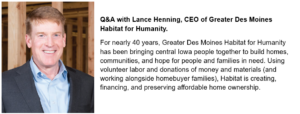
Financial Perspectives: We’re familiar with your homebuilding work but didn’t realize that you are also involved in financing and repairs.
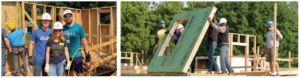
Lance Henning: Most people know about Habitat volunteers and our mission to build homes. That’s the physical part of our work. And over the years, we’ve built more than 500 homes across the metro area. But underlying that work is the growing need to make home ownership affordable for more people. That’s why we also provide community-supported, below-market rate loans for the families purchasing our homes.
On the preservation side, we provide repairs to help people stay in their homes. Everything from new roofs to handicapped access ramps, water heaters, and more.
FP: How do you select the families you work with?
LH: One of our challenges we see is that many people don’t believe they can be homeowners.
Typically, we work with households earning less than 80 percent of central Iowa’s median income, and it often takes someone else to encourage them to connect with us. Only about 30 percent of the people who knock on our door are ready for home ownership. We help them assess where they are, provide mortgage counseling, and help them create a plan.
Still, the number of folks coming through the door is well above our capacity on the number of home ownership opportunities we can create.
FP: Affordability is probably more important than it’s ever been.
LH: It’s important in both the initial homebuying process as well as the long-term life of the property. Volunteers and donations make the construction costs very efficient. The community allows us to provide mortgages that families can afford, no more than 30 percent of their income. In the event of a resale, buyers agree to sell to other low-income families. So lasting affordability is baked in from the beginning.
FP: What are other long-term results of your work?
LH: More than the physical houses, themselves, there’s the impact they have on the generational wealth-building success of the families and the children who live in them. Studies suggest that, on average, the assets of low-income homeowners are many times greater that the assets of low-income renters. Research also points to improved health and wellbeing for families who are in safe, stable home ownership situations.
FP: How many projects are you currently working on in central Iowa?
LH: We just closed on the last home in a 15-house subdivision on the northeast side of Des Moines, which means we’ll be completing at least 40 homes, this year, possibly 42. That includes a couple of houses that are part of the tornado recovery in Greenfield. We’re hoping to do as many as 50 homes in 2026.
FP: News stories make it look like anyone can volunteer. Is that true?
LH: It is! I think a lot of people are surprised at what they can accomplish on a construction site with just a little bit of guidance. If you want to help, we’d be happy to welcome you. We just ask that you contact us ahead of time via email or the website, so we can match you with the right project.
FP: What type of material and financial support do you receive?
LH: Financial gifts of any size are appreciated and make a difference. Some folks give a few dollars a month. Others commit to several thousand per year. We’re fortunate to enjoy the support of local businesses and we pursue grants that match our mission and needs.
Donated building materials, working appliances, tools, and more are sold in our ReStore shops, producing income that covers our overhead. As a result, all the financial gifts we receive are 100 percent invested in the families, houses, and projects we’re working on.
FP: How can people find out more about you?
LH: I invite them to visit our website, gdmhabitat.org.